
A guide to the safe identification of hazardous chemicals
When working with hazardous chemicals, it is essential that risks can be identified quickly and accurately. GHS hazard pictograms play a vital role in the correct identification, handling, and storage of hazardous substances.
GHS (Globally Harmonized System) is an internationally recognised classification and labelling system developed by the United Nations. It provides a consistent approach to identifying hazardous chemicals across international markets.
Within the European Union, GHS is implemented through the CLP Regulation (Classification, Labelling and Packaging), which establishes the requirements for classifying, labelling, and packaging hazardous substances and mixtures.
The purpose is to create a common visual language that enables employees and contractors to identify hazards quickly and handle chemicals safely.
Get expert advice on the right solution
Call us on +45 221 221 88 or request a quote
– we'll get back to you shortly.
Why are GHS hazard pictograms important?
Correct use of GHS hazard pictograms is an essential part of workplace safety and helps companies comply with applicable legislation.
The pictograms support the safe handling, storage, and transportation of hazardous chemicals.
Hazard identification
Clearly identifies whether a product is:
Flammable
Corrosive
Toxic
Hazardous to the environment
Correct selection of personal protective equipment
Supports the selection of appropriate:
Protective gloves
Safety goggles
Respiratory protection
Other personal protective equipment (PPE)
Safe storage and handling
Helps prevent hazardous situations and unintended chemical reactions.
Compliance and workplace safety
Supports compliance with the CLP Regulation while contributing to a safer working environment.
Requirements for chemical labelling
Hazardous chemicals must be labelled correctly in accordance with the CLP Regulation.
The purpose is to ensure that employees, technicians, and other users can quickly identify hazards and take the necessary safety precautions.
Correct chemical labelling includes:
GHS hazard pictograms
Signal words
Hazard statements
Precautionary statements
Product identification
Clear and durable identification is therefore essential in industrial facilities, laboratories, utilities, and manufacturing environments.
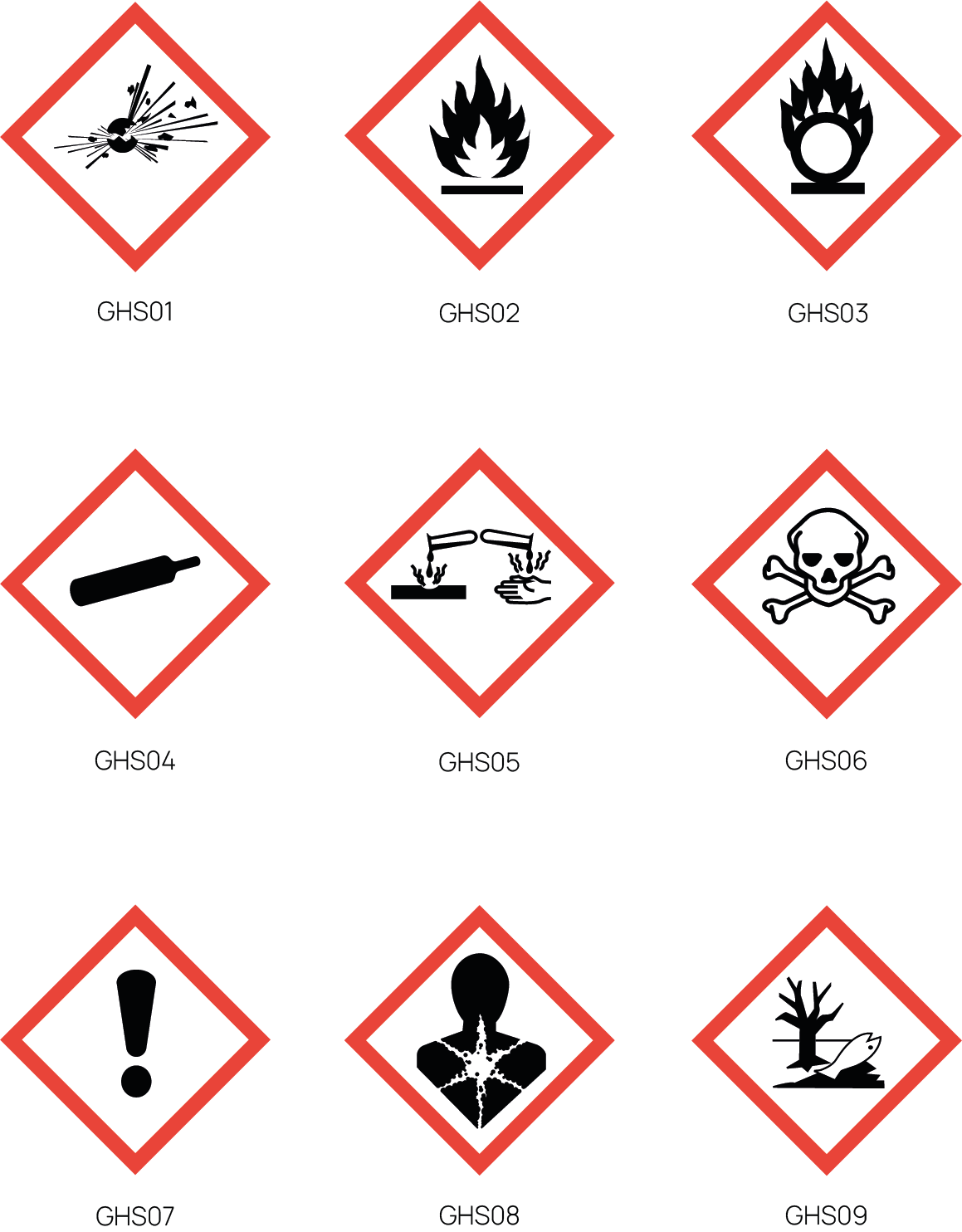
Meaning of the GHS hazard pictograms
-
Explosive substances, mixtures, and articles that may explode due to heat, sparks, impact, or friction.
-
Flammable gases, liquids, and solids, including substances that may ignite spontaneously or release flammable gases when in contact with water.
-
Oxidising substances that may cause or intensify fire by supplying oxygen to other materials.
-
Gases stored under pressure, such as gas cylinders.
May explode if heated.
Also includes refrigerated (cryogenic) gases that may cause severe cold burns or frostbite.
-
Substances that are corrosive to metals and may cause severe skin burns and serious eye damage.
-
Highly toxic or fatal substances that may cause serious harm through swallowing, skin contact, or inhalation—even in very small quantities.
-
Substances that may cause irritation to the skin, eyes, or respiratory system.
May also cause allergic skin reactions, drowsiness, or dizziness.
-
Substances that may cause long-term health effects, including:
Cancer
Genetic defects
Reproductive toxicity
Organ damage
Respiratory sensitisation
-
Substances that are toxic to aquatic organisms, often with long-lasting environmental effects.
Looking for durable GHS safety marking?
TG Technology supplies robust industrial signs, TAG markers, and identification solutions for manufacturing, process industries, and technical installations.
We help companies implement durable and compliant safety marking solutions that withstand demanding industrial environments.
Get expert advice on the right solution
Do you have questions about material selection, marking methods, or durability?
Call us on +45 221 221 88 or request a quote
– we'll get back to you shortly.